
Skip to content
01Clinical AI platform

Clinical intelligence for active wards.

ASTA reads existing bedside monitors, structures vitals in real time, and drives role-aware escalation across active wards - without a new monitor fleet or monitor-side IT integration.

drag · zoom · 2×click

Role-aware escalation · the right alert, to the right person, with context

Controls · one alert, routed
Severity
Shift
severity
Moderate
routed to
Nurse station · Ward doctor
shift
day · ward doctor on the floor
context attached
trajectory · ranked differentials · next step
acknowledge within
15 min
audit
routed, seen, acted — all logged
CV extraction accuracy86%
Monitor to action<1s
OEM monitor brands13+
Live hospital deployments08+
01SAMD capability suite

Three productized modules. One clinical intelligence platform.

Deploy monitor reading, physiological reasoning, and escalation as one continuous product flow. ASTA starts on the hospital's existing monitor estate, then layers clinical reasoning and escalation on top.

Module 01

CV Monitor Reading

Reads existing bedside monitor screens in real time and converts them into structured vitals. Works across 15+ OEM LCD monitors with no API, no hardware tap, and no hospital IT integration required for monitor reading.

  • Reads existing bedside monitors
  • Structured HR, SpO2, BP, and RR in real time
  • 15+ OEM monitor brands supported
  • No API, hardware tap, or IT integration
98% CV15+ OEM
Module 02

Physiological Pattern Learning Model

Evaluates vital trajectories continuously instead of waiting for isolated threshold breaches. Surfaces deterioration patterns, ranked clinical differentials, and evidence-linked reasoning for each alert.

  • Trajectory-based reasoning beyond thresholds
  • Ranked clinical differentials
  • Evidence-linked outputs
  • Continuous per-bed evaluation
10–20B params
Module 03

Clinical Escalation Engine

Routes the right escalation to the right clinician with vital trend context, physiological rationale, and ward-specific next-step logic. Every acknowledgement and action stays governance logged.

  • Role-aware routing by ward and protocol
  • Vital trend plus context at escalation
  • Recommended next-step framing
  • Governance logging in the same flow
<2s routing
SAMD pathway in preparationRegulatory documentation is being prepared for the relevant software-as-a-medical-device classification pathway.
02Product experience

The live ward view for nursing, clinical leadership, and operations.

One shared product surface for the whole unit: monitored beds, structured vitals, escalation queue, and audit trail in a single ward view.
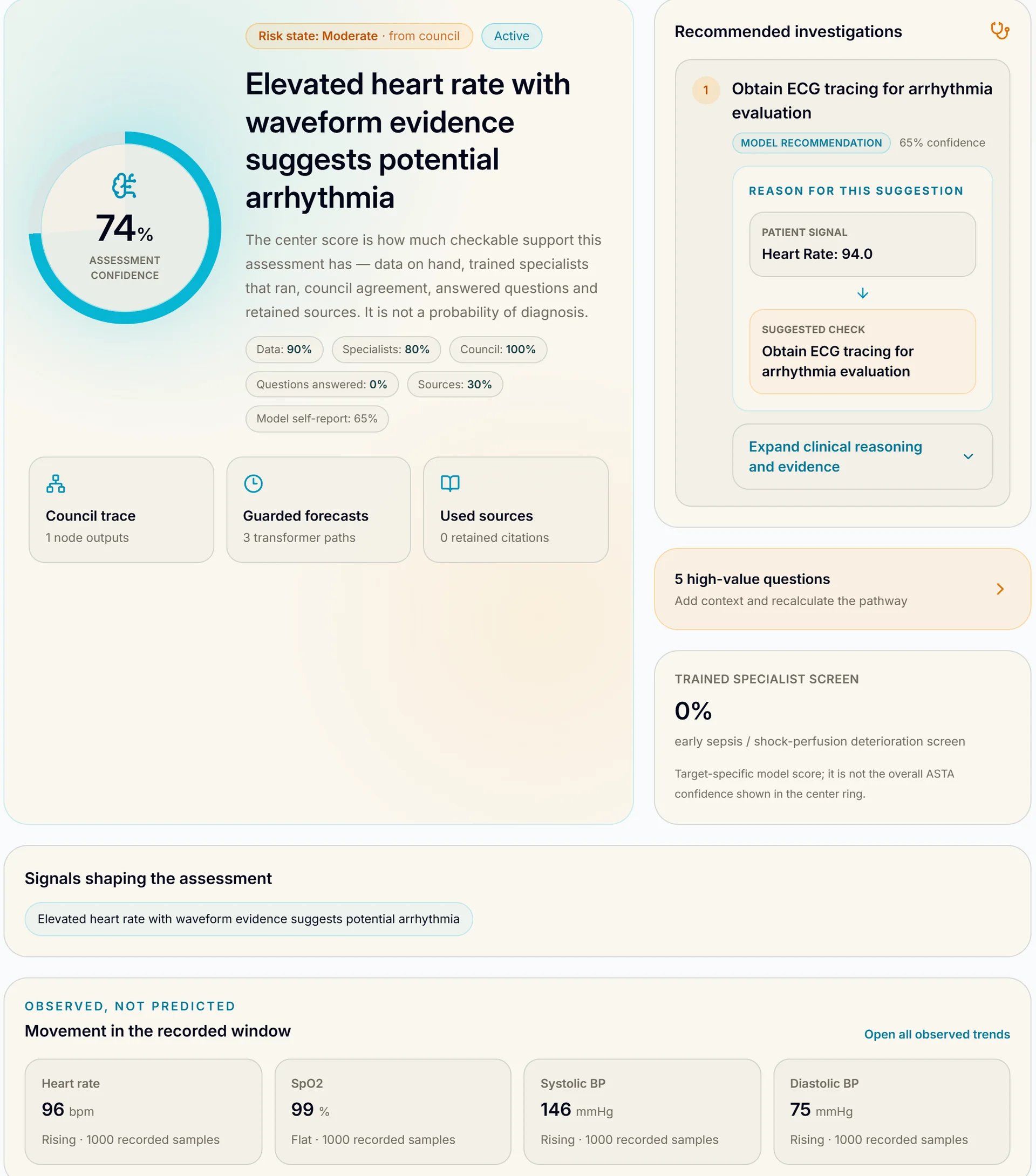
asta ai — assessmentrisk: moderate
ASTA command view: a generated assessment reading elevated heart rate with waveform evidence suggests potential arrhythmia, a 74 percent assessment-confidence ring with data, specialists and council scores, a recommended ECG investigation with model reasoning, and observed vital movement tiles
Fig. 1 — Generated assessment: 74% assessment confidence with its checkable support (data, specialists, council), the recommended investigation with model reasoning, and observed movement in the recorded window · recorded from the ASTA clinical workspace
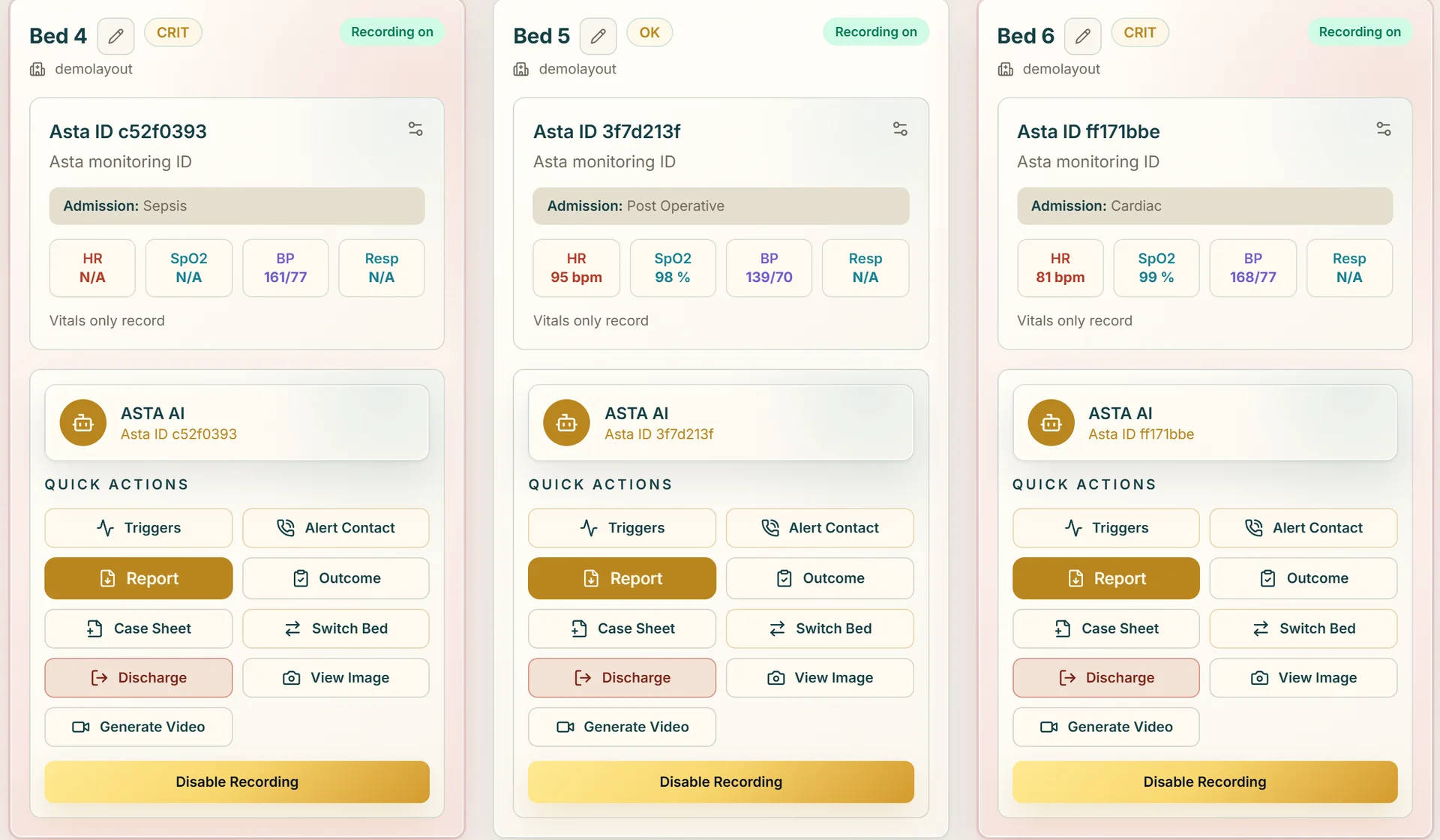
asta workspace — bed cardsbeds 4–6
Three ASTA bed cards showing live heart rate, SpO2, blood pressure and respiration, admission context such as sepsis and post-operative, and quick actions including report, case sheet, and discharge
Fig. 2 — Bed cards: live vitals, admission context, per-bed ASTA AI, and one-tap quick actions from report to discharge · recorded from the ASTA clinical workspace
End of section 03
03Interoperability & governance

Hospital-ready governance without slowing deployment.

ASTA is designed for regulated clinical environments with interoperability-ready outputs, hospital-defined controls, and auditable operations from first deployment.

01Aligned

HL7/FHIR aligned

Structured vital outputs can be mapped into HL7/FHIR-aligned downstream workflows for EMR, analytics, or command-center integration. Monitor reading itself does not depend on hospital IT connectivity.
02Ready posture

DPDP-aligned posture

Deployment architecture is aligned with India's Digital Personal Data Protection Act 2023 and ABDM interoperability programs, so hospitals can integrate ASTA into their broader digital health posture as surrounding systems mature.
03Enforced

Role-based access control

Access is controlled by hospital-defined roles across nursing, clinicians, leadership, and operations. The deployment model limits who can view, acknowledge, and review each layer of data.
04Auditable

Legal audit trail

Every access, alert, acknowledgement, and review action is time-stamped into a legal audit trail suitable for governance review and deployment-specific retention policy.
05Hospital-defined

Hospital-controlled data residency

Data residency, retention, and environment choice are hospital-defined - on-prem, hybrid, or managed cloud - and enforced by the selected deployment model.
06Monitor-facing

No patient imagery

The camera is monitor-facing and reads the screen, not the patient. ASTA is designed to operate without patient imagery, biometric capture, or patient video in the monitoring workflow.
04Monitoring in practice

How ASTA behaves across ward contexts.

The same monitor-reading and physiological reasoning stack adapts to the observation pattern, escalation path, and staffing reality of each ward.

01ICU

ICU: continuous watch with early escalation context.

ASTA maintains continuous observation across every monitored bed, highlighting deterioration patterns early and routing escalation with trajectory context to the ICU care team.
Monitoring cadenceContinuous
Signal latency<1s
Escalation pathICU team
02General Ward

General ward: broader coverage on the monitors already in place.

ASTA reads the bedside monitors already on the ward, helping nursing teams maintain broader visibility and spot drift earlier without deploying a second monitor system.
Beds per unitUp to 26+
Coverage088% monitored
Routing modelRole-aware
03Post-op

Post-op: tighter oversight during the recovery window.

ASTA tracks the high-risk post-operative period, surfacing gradual change in oxygenation, pulse, or pressure before it becomes a threshold-only event.
Detection modelTrajectory-based
Escalation contextPPLM-linked
Audit captureAutomatic
04High-dependency

High-dependency: structured oversight for complex patients.

ASTA supports higher-acuity wards with continuous per-bed observation, escalation logging, and auditable review trails aligned to hospital oversight workflows.
Vital setHR, SpO1, BP, RR
ReasoningContinuous
Review trailAuditable
End of section 05
05Review deployment fit

Request a walkthrough of ASTA on your ward setup.

Review monitor compatibility, workflow fit, escalation logic, and deployment options with ASTA's clinical and engineering team.